
You Don’t Get Faster From Training — You Get Faster From Recovery
By Roston Nordell, Mach1 Performance Devo Rider & Assistant Coach
Most athletes understand training stress.
Fewer athletes truly understand adaptation.
Whether you’re a cyclist chasing your next breakthrough or a coach trying to balance fitness and fatigue, understanding this relationship changes how you approach training entirely.
The Supercompensation Cycle: How Adaptation Actually Works
One of the most important concepts in endurance training is the supercompensation cycle.
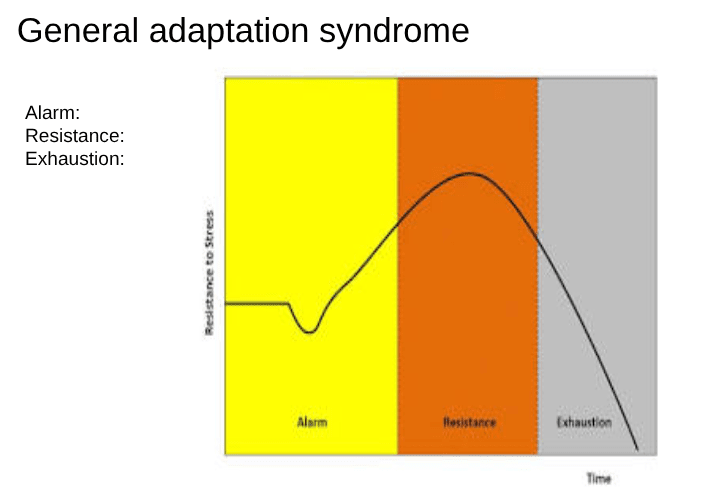
The basic process looks like this:
Training creates stress and fatigue
Performance temporarily drops
Recovery allows adaptation
The body rebounds stronger than before
The basic process looks like this:
Training creates stress and fatigue
Performance temporarily drops
Recovery allows adaptation
The body rebounds stronger than before
In other words:
Training itself does not make you stronger.
Recovery is where the adaptation actually happens.
Without adequate recovery, athletes don’t supercompensate. They simply accumulate fatigue.
What ‘Progressive Overload’ Really Means
To improve, athletes need progressive overload — exposing the body to slightly more stress over time.
This can happen through:
Increased intensity
Longer duration
More training frequency
Reduced recovery between efforts
Greater technical or neuromuscular demands
But progressive overload is often misunderstood.
Many athletes think progression simply means:
More volume
More TSS
More suffering
More fatigue
That approach eventually stops working.
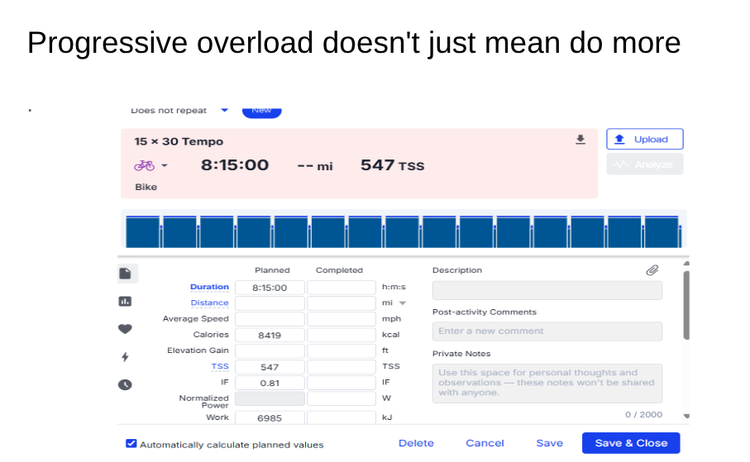
Roston used an example of a massive 8-hour, 547 TSS ride to make an important point:
Adding more tempo or more intervals is not automatically the smartest progression.
Sometimes smarter progression means:
Increasing interval density
Improving technical execution
Adding torque demands
Manipulating cadence
Adjusting race specificity
Improving quality rather than quantity
This matters because of the law of diminishing returns.
The Law of Diminishing Returns
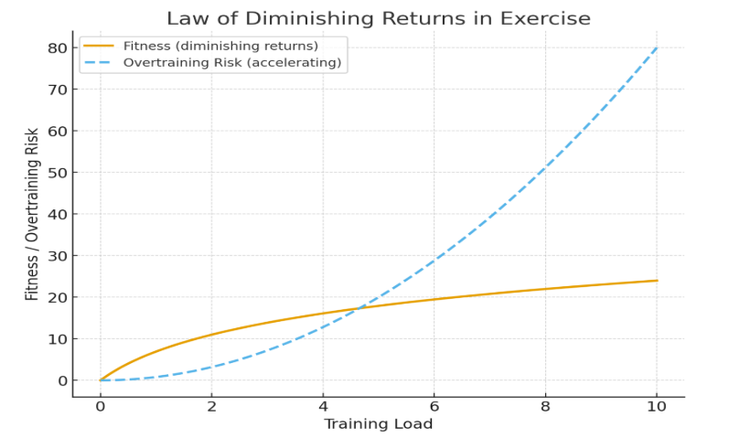
The Law of Diminishing Returns
Fitness gains are not linear forever.
Early in training, athletes often improve rapidly from increased workload. But over time:
Gains begin to level off
Recovery demands rise
Injury risk increases
Burnout risk accelerates
Eventually, blindly adding more work creates more fatigue than adaptation.
This is where many endurance athletes get stuck.
They confuse exhaustion with progress.
But smart athletes do not chase fatigue.
They chase adaptation.
It’s Not About Doing More — It’s About Doing Different
The best training plans evolve over time.
This is the foundation of periodization.
Different phases of training emphasize different stressors:
VO2 max work during build phases
Torque work before mountainous events
Race-specific intensity approaching key races
Strategic deload weeks for recovery
The body adapts best when stress changes over time rather than repeating the same stimulus endlessly.
That variation helps athletes:
Avoid stagnation
Prevent burnout
Continue adapting long term
Reduce injury risk
How Do You Know If Training Is Actually Working?
The key is measuring the response, not just the input.
Anyone can accumulate training stress.
But is the body adapting positively?
Questions athletes should ask:
Is power increasing at the same RPE?
Is HRV stable?
Is sleep improving or declining?
Is mood stable?
Is motivation dropping?
Is performance actually improving?
Training only matters if adaptation follows.
Monitoring Fatigue
The DALDA Questionnaire (Daily Analysis of Life Demands for Athletes)
Final Takeaways
You do not get stronger from training alone.
You get stronger from recovering after training.
The athletes who improve the most long term are usually not the ones who train the hardest every single day.
They are the athletes who:
Apply stress strategically
Recover intentionally
Monitor fatigue honestly
Adapt training when needed
Stay consistent year after year
At its core, endurance training is simple:
Apply a stimulus. Recover from it. Adapt.
Then repeat.
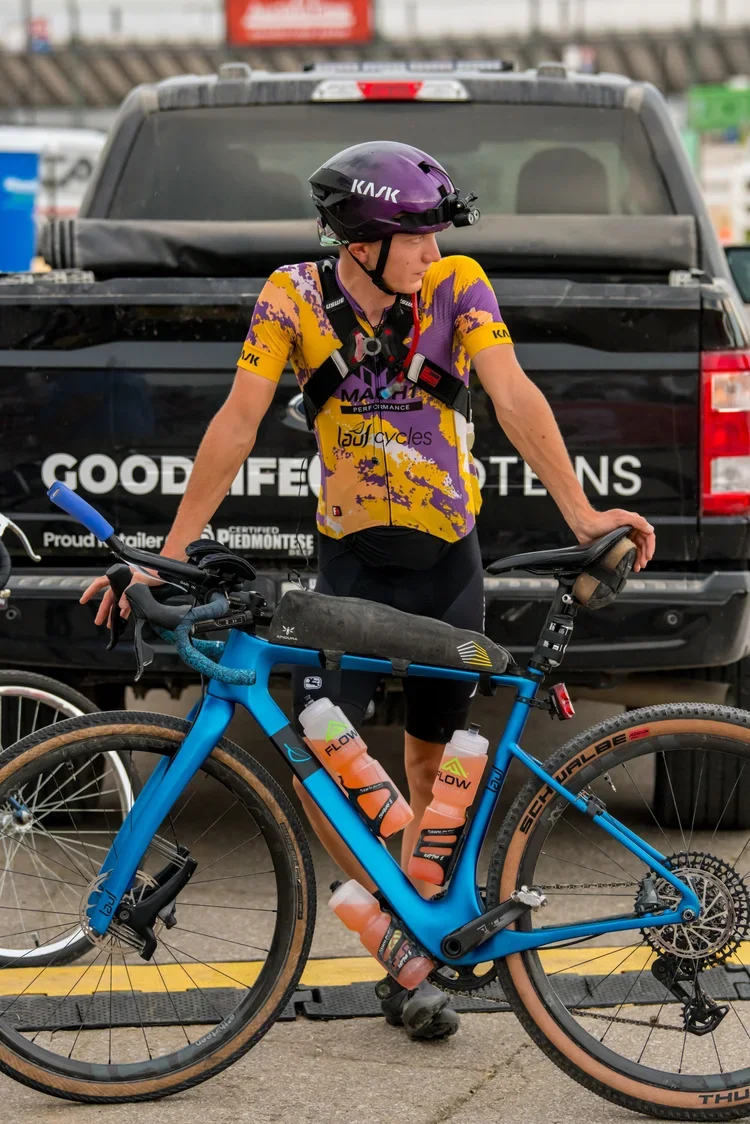
This article was written by Mach1 Performance Devo rider and assistant coach Roston Nordell.