
Is the Stretch Really Where All the Gains Happen?
If you’ve spent any time around strength content lately, you’ve probably heard this idea repeated as fact:
“The stretch portion of an exercise is where all the muscle growth happens.”
Some have taken that a step further:
Only train in the lengthened position
Chase deep stretch at all costs
Shortened-range work is “junk volume”
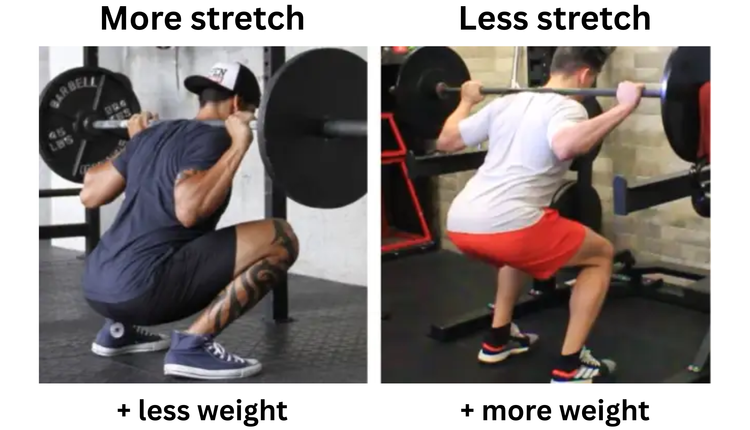
Like most training trends, this one started with real research—but the message got oversimplified along the way.
Let’s slow it down and look at what the science actually says, what it doesn’t, and how endurance athletes should apply this without wrecking themselves in the gym.
Where The “Stretch” Idea Came From
Over the last few years, multiple studies have shown that exercises which load a muscle in a longer length can lead to greater hypertrophy in certain contexts.
Some of the most cited findings:
Maeo et al. (2021) showed greater muscle growth when training at longer muscle lengths compared with shorter ones.
Pedrosa et al. (2022) found that partial reps performed in the lengthened range produced more hypertrophy than partials in the shortened range.
Schoenfeld et al. (2021) concluded that exercises emphasizing high mechanical tension (often occurring at longer muscle lengths) can enhance hypertrophic adaptations.
These are legit, well-designed studies. The data is real.
But here’s the key distinction:
👉 They compared lengthened-range work to shortened-only work—not to full-range, well-programmed training.
That nuance matters.
What Actually Drives Muscle Growth (Still)
Hypertrophy hasn’t changed just because social media did.
Muscle growth is primarily driven by:
Mechanical tension
Motor unit recruitment
Proximity to failure
Sufficient volume over time
Recovery and repeatability
Lengthened positions often increase mechanical tension, which is why they show up favorably in studies. But tension doesn’t exist only in the stretch—and stretch alone isn’t anabolic.
A muscle doesn’t grow because it’s stretched.
It grows because it’s producing force under load.
The Trade-Off: Depth vs Load
Here’s the part that almost never gets mentioned:
To get that “big stretch” position (like a very deep squat or split squat) you often have to lower the load to maintain control and good form.
On the flip side: If you don’t go as deep (but still use a solid, safe range of motion), you can usually add more weight.
Both can create high mechanical tension, just in slightly different ways.
So in practice:
A deep Bulgarian split squat with moderate load and great control can be a fantastic lengthened-bias hypertrophy tool.
A slightly shallower split squat with heavier load and full control can also be a fantastic hypertrophy tool.
The real question isn’t: “How deep can I go at any cost?”
It’s: “Where can I move well, keep tension, and progressively overload over time?”
More depth with good control and enough load? Great.
More depth that forces you into instability, sloppy reps, or joint irritation? Not worth it.
What the Research Actually Supports
Here’s the accurate takeaway from recent literature:
✅ Training at longer muscle lengths can enhance hypertrophy in some muscles and contexts
Not all muscles are meant to stretch the same way. Bi-articulate muscles (crossing two joints) are able to stretch further than most other muscles:
Hamstrings
Quads
Calves
Triceps
Studies consistently show that exercises that stretch these muscles and go through their full ROM grow them faster.
✅ Stretch-mediated tension is one hypertrophic stimulus
✅ Full range of motion still matters
✅ Volume, effort, and progression matter more than any single joint angle
✅ No single portion of the rep works in isolation
Most authors emphasize integration, not replacement.
Even studies favoring lengthened training consistently note that results depend on:
Total training volume
Intensity
Proximity to failure
Program design and recovery
Practical Applications
Instead of chasing the stretch as a magic trick, here’s how to apply this intelligently.
1. Prioritize Full, Challenging Range of Motion
The strongest evidence still favors training through a full, controlled range of motion for hypertrophy.
That doesn’t mean every exercise must maximize stretch at the bottom; it means the muscle should experience meaningful tension across as much of its usable ROM as possible.
Examples:
RDLs instead of only hip thrusts (tension maintained through long muscle lengths)
Bulgarian split squats instead of only partial leg press
Incline curls instead of only peak-contraction cable curls
These movements load the muscle through a longer arc, not just one “favored” point.
2. Use a Range You Can Actually Own
Depth is a dial, not a binary.
If you can hit full depth with control, great—live there and progress slowly.
If going “max depth” turns every rep into a survival rep, back off slightly, load it a bit heavier, and own that range.
Both can grow muscle. The winning combo is:
Good technique + meaningful load + tension through a challenging but controlled ROM.
3. Respect Recovery (Especially as a Cyclist)
Lengthened work often produces more soreness and fatigue.
For cyclists lifting in the off-season:
Start with fewer sets than you think
Progress slowly on both load and depth
Expect more soreness from RDLs and split squats than machine work
Make sure your lifting doesn’t compromise key bike sessions
The Bottom Line
The stretch isn’t magic. It’s a tool.
Muscle growth still comes from:
Appropriate load + sufficient effort + repeatable recovery over time
If your program has those things, adding lengthened-bias exercises and smart depth can absolutely help.
If it doesn’t, chasing extreme ROM or “stretch only” is just noise.